Wash 1000g of black sesame seeds with pure water one to two times.
Watch out
Vegetables must be thoroughly drained before putting them into the wok, otherwise water will cause oil splattering.
Allergen labels are AI-generated and may be incomplete or wrong. If you have a food allergy, always verify every ingredient yourself.
Recipe details are AI-generated from the video and may contain errors — for reference only.
Wash 1000g of black sesame seeds with pure water one to two times.
Watch out
Vegetables must be thoroughly drained before putting them into the wok, otherwise water will cause oil splattering.
Drain water with a sieve, shake until there are no drips, no air-drying needed.
Watch out
Shake evenly when draining to avoid excess water residue.
Pour into the wok, turn to medium heat and stir-fry slowly to let the water evaporate; stir until it feels lighter and you hear continuous popping sounds, continue until temperature reaches 140°C to 150°C, then immediately pour into a baking tray and spread flat to cool down quickly.
local_fire_departmentMedium heat, approx. 140°C to 150°CWatch out
Sesame seeds must be immediately poured into a tray to cool when reaching around 145°C, otherwise overheating will cause a burnt taste.
Pour 420g of caster sugar and 100g of water into a non-stick pan, turn to medium-low heat, stir slowly with a heat-resistant silicone spatula to accelerate melting, and completely melt the caster sugar without any particles before the water boils.
local_fire_departmentMedium-low heatWatch out
Caster sugar must be completely melted before the water boils, otherwise the final product will recrystallize.
After the caster sugar is completely melted without particles, add 550g of maltose and mix thoroughly.
local_fire_departmentMedium-low heatWatch out
It is recommended to preheat maltose before pouring to reduce residue.
When dense bubbles float up, add 60g of vegetable oil, stir well, turn to low heat and continue boiling slowly.
local_fire_departmentLow heatWatch out
Continue stirring after adding vegetable oil, otherwise it will easily burn at the bottom.
Once the syrup is boiled to a hard-crisp state, remove from heat immediately and stir quickly, then instantly pour in all the black sesame seeds and peeled hazelnuts kept warm above 60°C, and mix well until no loose black sesame is seen.
local_fire_departmentOff heatWatch out
You must immediately pour in black sesame and hazelnuts kept above 60°C, otherwise the temperature drop will solidify the syrup and make it impossible to mix
otherwise, the syrup will lump and ruin the entire batch
Must wear anti-scald gloves when moving hot cookware or handling high-temperature syrup to avoid serious burns.
Before the temperature drops below 70°C, pour the sesame candy into a 28cm square baking pan with sides brushed with vegetable oil, wear anti-scald gloves to spread and flatten the soft sesame candy.
Watch out
Must be poured and spread into the tray before temperature drops below 70°C, otherwise it cannot be shaped after hardening
otherwise, the candy will harden and cannot be flattened
Unmold when surface temperature approaches 70°C, use a ruler and kitchen curved knife to cut into 6.5 cm wide strip embryos using a slicing method; note that the strips are very soft right now, do not press hard to avoid deformation.
local_fire_departmentApprox. 70°CWatch out
The strips are very soft at this time, do not press hard when cutting to avoid deformation, otherwise the cut shapes will be uneven.
Focus when using sharp kitchen knives to cut hard candy, keep the blade moving forward smoothly to avoid finger injuries.
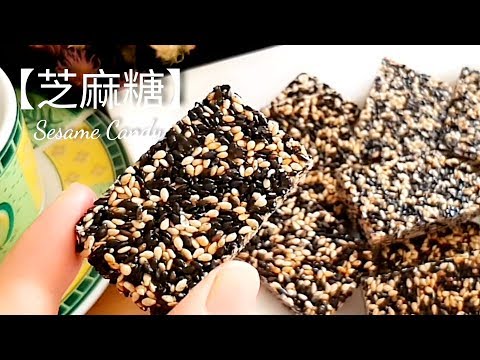
When the strip surface temperature drops to 60°C, use a kitchen curved knife to slice forward with the tip pointing down, cutting into appropriately sized sesame candy pieces.
local_fire_departmentApprox. 60°CWatch out
If the strip temperature is too low it will be too hard and difficult to cut, if too high it will easily deform
maintaining 50°C to 60°C is the ideal operating temperature, otherwise the candy pieces will shatter or deform